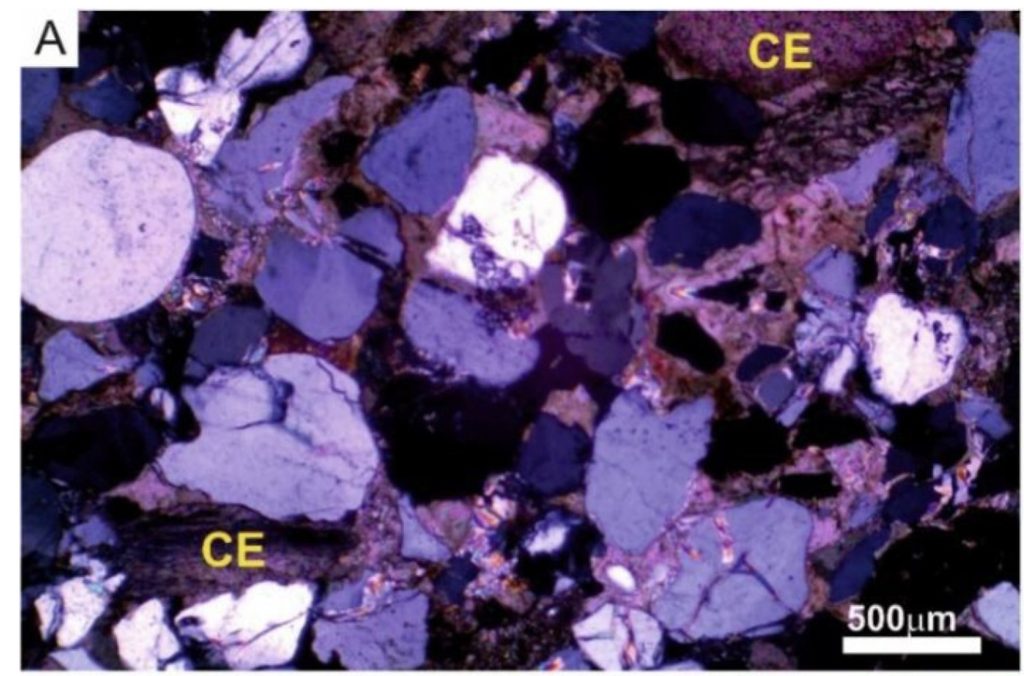
This study investigates the Cenozoic geodynamic, palaeogeographic, and palaeoclimatic evolution of the Moroccan NW African Margin through petrographic analysis of 18 stratigraphic sections across the Maghrebian Flysch Basin and the External Rif Zone. Detrital samples (comprising arenites and microconglomerates) are classified as quartzarenites, sublitharenites, and litharenites. These rocks are dominated by quartz and lithics, with scarce intrabasinal carbonate content. Provenance signatures reveal a polycyclic origin with the presence of low-to medium-grade metamorphic sources, likely derived from pre-Alpine orogens (African Craton, Pan-African belt, and/or Variscan mesetas), with contributions from plutonic intrusions. During the Oligo-Miocene, sections show increased quartz, particularly in distal foreland domains, reflecting tectonic uplift and enhanced recycling. Minor mafic input in the Intrarif/Mesorif suggests episodic oceanic crust or subduction-related volcanic contributions. Palaeoclimate proxies suggest moderate to high chemical weathering, with peak warming and aridity during the Paleocene-Eocene and Middle-Late Miocene intervals. Textural maturity ranges from well-sorted quartzarenites to submature arenites, supported by low content of feldspar and unstable grains content, suggesting a history of prolonged sediment transport, multicyclic recycling, and diagenetic overprinting. Comparative analysis with the South Iberian, North Tunisian, West Adriatic and Moldavidian- Scythian-Moessian Margins show inmature sediments in the internal areas, ultramature sediments close to the foreland and mixed succession of the two formers in intermediate positions. In particular, the South Iberian Margin shares quartz-lithic dominance but lacks metamorphic/plutonic clasts, whereas the West Adriatic Margin is characterized by persistent arc-derived volcanoclastics. These disparities highlight distinct geodynamic and palaeogeographic regimes across the Western Tethys during the Cenozoic. Our findings constrain orogenic recycling, sediment routing, and climatic feedbacks in the NW African Margin, providing insights for Mediterranean Alpine belts geodynamic reconstructions.
Cite as: Cañaveras, J. C. and Martín-Martín, M. (2026): Deciphering the Cenozoic detrital record of the External Rif Belt (Northern Morocco): insights for the evolution of the NW African Margin. Journal of African Earth Sciences, Volume 235, 105970.