Deciphering the Cenozoic detrital record of the External Rif Belt (Northern Morocco): insights for the evolution of the NW African Margin 


This study investigates the Cenozoic geodynamic, palaeogeographic, and palaeoclimatic evolution of the Moroccan NW African Margin through petrographic analysis of 18 stratigraphic sections across the Maghrebian Flysch Basin and the External Rif Zone. Detrital samples (comprising arenites and microconglomerates) are classified as quartzarenites, sublitharenites, and litharenites. These rocks are dominated by quartz and lithics, with scarce intrabasinal carbonate content. Provenance signatures reveal a polycyclic origin with the presence of low-to medium-grade metamorphic sources, likely derived from pre-Alpine orogens (African Craton, Pan-African belt, and/or Variscan mesetas), with contributions from plutonic intrusions. During the Oligo-Miocene, sections show increased quartz, particularly in distal foreland domains, reflecting tectonic uplift and enhanced recycling. Minor mafic input in the Intrarif/Mesorif suggests episodic oceanic crust or subduction-related volcanic contributions. Palaeoclimate proxies suggest moderate to high chemical weathering, with peak warming and aridity during the Paleocene-Eocene and Middle-Late Miocene intervals. Textural maturity ranges from well-sorted quartzarenites to submature arenites, supported by low content of feldspar and unstable grains content, suggesting a history of prolonged sediment transport, multicyclic recycling, and diagenetic overprinting. Comparative analysis with the South Iberian, North Tunisian, West Adriatic and Moldavidian- Scythian-Moessian Margins show inmature sediments in the internal areas, ultramature sediments close to the foreland and mixed succession of the two formers in intermediate positions. In particular, the South Iberian Margin shares quartz-lithic dominance but lacks metamorphic/plutonic clasts, whereas the West Adriatic Margin is characterized by persistent arc-derived volcanoclastics. These disparities highlight distinct geodynamic and palaeogeographic regimes across the Western Tethys during the Cenozoic. Our findings constrain orogenic recycling, sediment routing, and climatic feedbacks in the NW African Margin, providing insights for Mediterranean Alpine belts geodynamic reconstructions. 
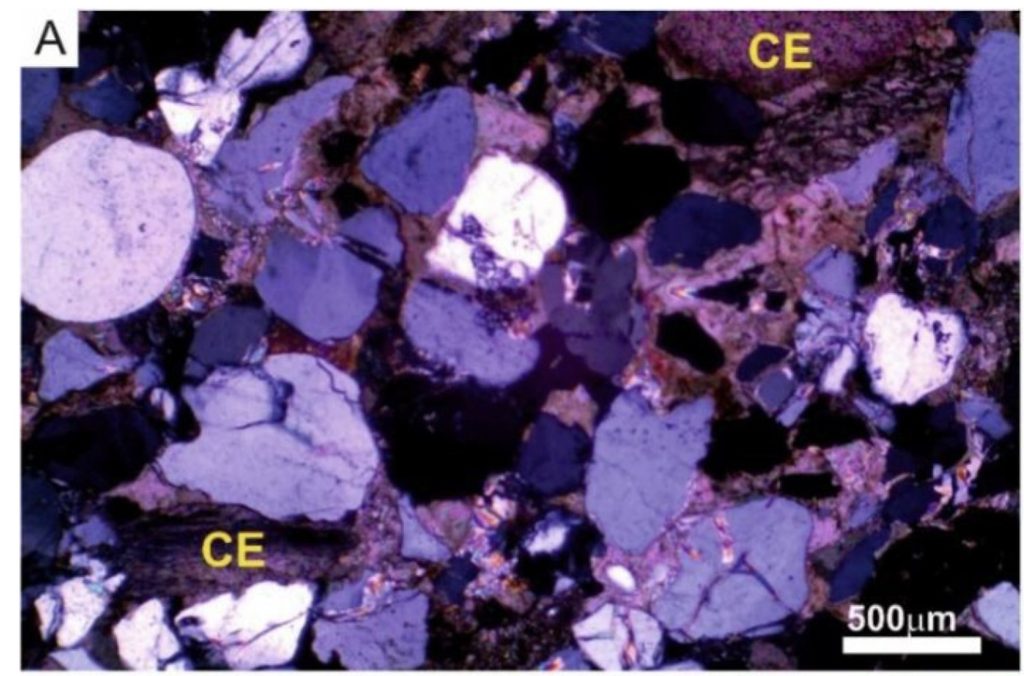
Photomicrograph of medium-grained Oligocene sublitharenite (Ib2 Group) mainly composed of subrounded to rounded quartz grains and carbonate fragments (CE). 39/15 sample, Oligocene, Section 8: Mezgalef (External Intrarif); crossed polars.

Cite as: Cañaveras, J. C. and Martín-Martín, M. (2026): Deciphering the Cenozoic detrital record of the External Rif Belt (Northern Morocco): insights for the evolution of the NW African Margin. Journal of African Earth Sciences, Volume 235, 105970.
Miocene evolution Moroccan External Rif Zone

The Miocene evolution of the External Rif Zone (NW Africa Plate) was determined through multidisciplinary analysis of fourteen successions. The updated stratigraphic framework shows how Miocene sediments rest on the Cretaceous–Paleogene terrains through unconformity surfaces, whereas it rests with sedimentary continuity in two sectors. After recognition of lithofacies and three unconformities located near the Oligocene–Aquitanian, Aquitanian–Burdigalian and Serravallian–Tortonian boundaries, the Miocene sedimentary record was divided into three stratigraphic intervals representing deep to shallow marine deposits as Aquitanian–Burdigalian, Langhian and Upper Serravallian–Missinian. The two oldest unconformites are restricted to the central sector, while the upper one is generalized and probably related to the nappe tectonics registered in all sectors of the External Rif. Data from analysis of tectofacies, petrology, mineralogy, meaning and implications of unconformities, and subsidence indicate that: (i) mass flow deposits (turbidites, slumps, olistostromes) are common in all successions but more frequent during the Lower Miocene; (ii) petrology of the detrital components of the arenites indicates recycled orogen-derived sediments, with quartz coming from erosion of metamorphic rocks of the Atlas orogen and/or the African craton; (iii)mineralogy of mudstones suggests a complex erosional evolution of local emerged areas derived from a mixture of contributions coming from the erosion of Upper Jurassic to Paleogene suites, and especially from kaolinite-rich Albian–Cenomanian to Paleogene successions with absence of a clear unroofing.


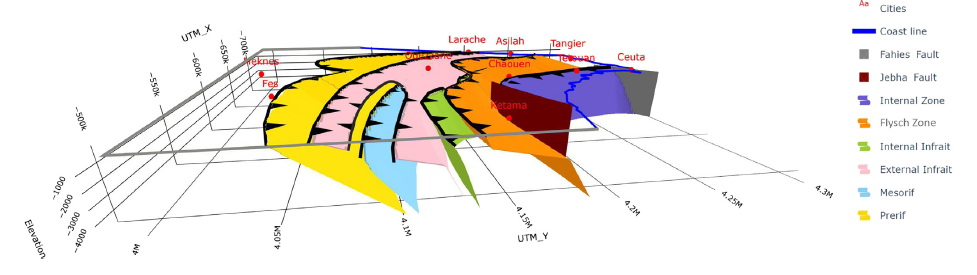
Display of the 3D structural model performed with Python codes; see file 3D_ZER_structural_model.HTML

The conjunction of all these clues reinforces the idea of a synsedimentary tectonics affecting themargin/basin system during the Miocene. A thickness analysis of the studied sedimentary successions allows proposing the evolution of the orogenic front and main depozones (foredeep, bulges, wedge-top and intramontane sub-basins) integrated in a complex foreland system migrating from north to south with the Atlas-Mesetas area acting as foreland during Miocene. The orogenic front moved from the Internal Intrarif to Mesorif and later to Internal Prerif. The main wedge-top basin also migrated from the Internal Intrarif to External Intrarif. The foredeep migrated from the Mesorif to the Internal Prerif,while the main forebulge was located in the External Prerif and a secondary bulge developed in the External Intrarif. Intramontane basins developed behind the orogenic front in relative extensional conditions moving from the Internal Intrarif to External Intrarif. The reconstructed Miocene evolution was inserted into a 2D paleogeographic geodynamic evolutionary model using GPlates software, and then compared to those reported in other external margins of the western Tethys (Betic Chain, Tunisian Tell, Sicilian Maghrebids and Apennines), revealing important similarities and local differences.

Cite as: Martín-Martín,M., Guerrera, F., Cañaveras, J. C., Alcalá, F. J., Serrano, F., Maaté, A., Hlilaf, R., Maaté, S., Sánchez-Navas, A., Miclăus, C., Tent-Manclús, J. E., Bullejos, M., 2024: Miocene evolution of the External Rif Zone (Morocco): Comparison with similar and lateral southern Mediterranean Tethyan margins. Sedimentary Geology 464 (2024) 106619