Nannoplankton Congress (INA 19) in Llandudno (Wales)

The 19 International Nannoplankton Association Congress took place on the coastal city of Llandudno (Wales) from September 9 until 13, 2024.

The Ceratoliths are a type of calcareous nannoplankton which allow to subdivided the Messinian and the Pliocene stages. A series of works by Carlos Lancis, José Enrique Tent-Manclús and José-Abel Flores, comparing Light Microscope and Scan Electronic Microscope image, have redefined the Messinian and Pliocene Ceratolithaceae Family and its unrevail its phylogenetic evolution.
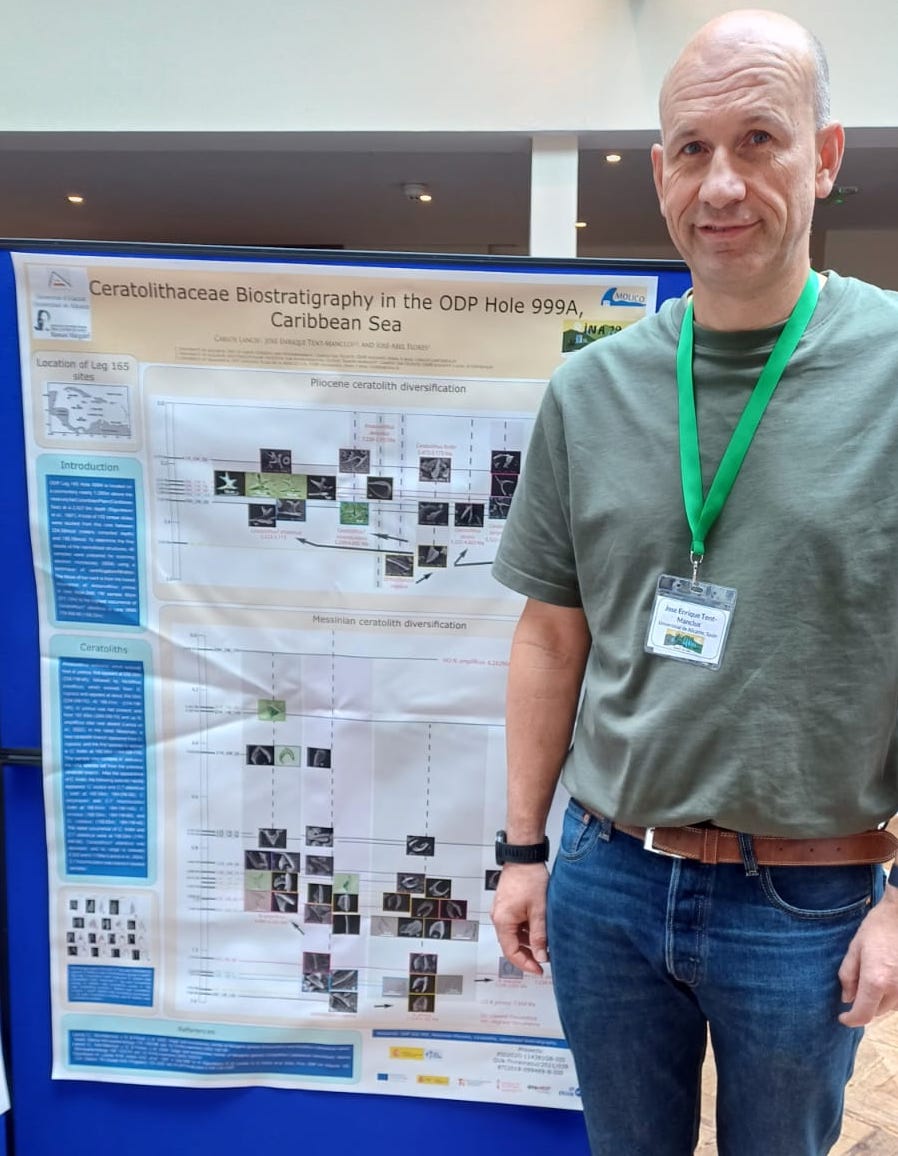
José Enrique Tent-Manclús in front od the poster of the ODP site 999A.

Three works published in the Journal of Nannoplankton Research (JNR) abstract volume (here):

  1. Lancis, C., Tent-Manclús, J. E. y Flores, J.-A. (2024): Ceratolithaceae biostratigraphy of ODP Hole 999A, Caribbean Sea. Journal of Nannoplankton Research, 42-special: 71.
  2. Lancis, C., Tent-Manclús, J. E. y Flores, J.-A. (2024): Ceratolithaceae biostratigraphy of ODP Site 1237, equatorial Pacific. Journal of Nannoplankton Research, 42-special: 72.
  3. Lancis, C., Tent-Manclús, J. E. y Flores, J.-A. (2024): Structural developments within the Family Ceratolithaceae. Journal of Nannoplankton Research, 42-special: 73.
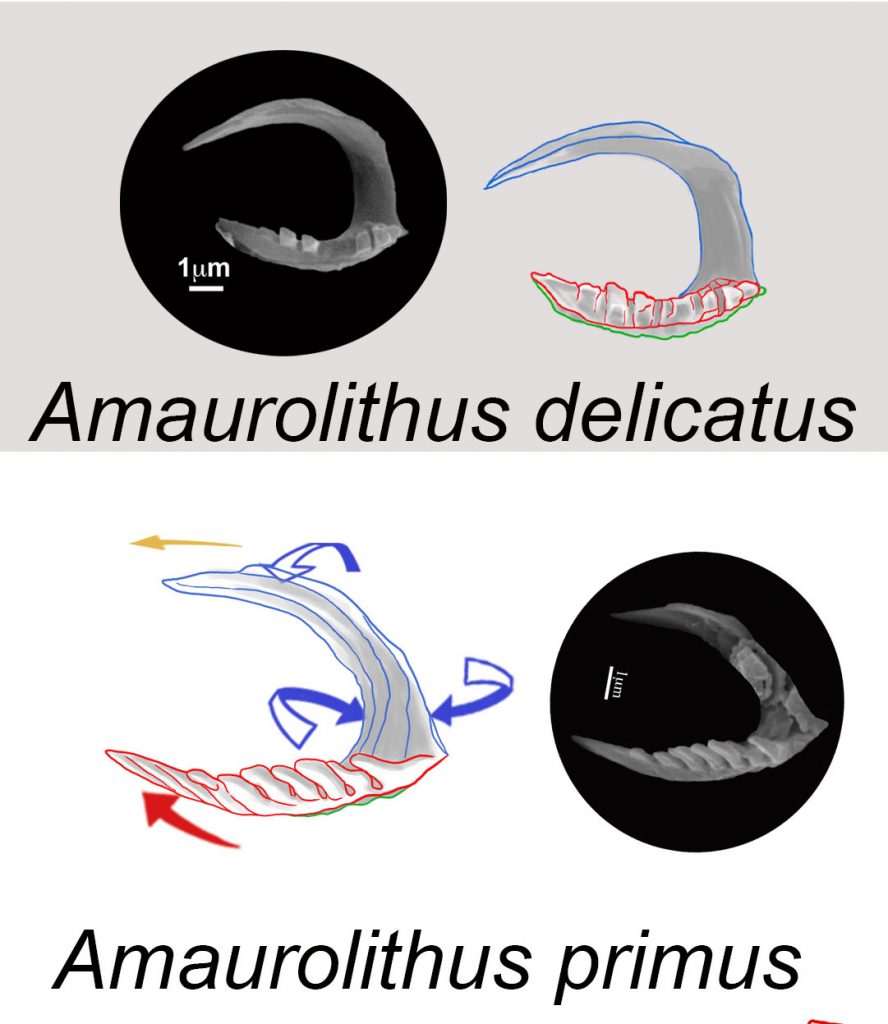
Evolution of Amaurolithus: Amaurolithus delicatus marking the Messinian bottom

After a complete study of the sediment samples from Ocean Drilling Program (ODP) Sites 999 and 1237 in the Caribbean Sea and Eastern Pacific Ocean in order to monitor the evolution of ceratoliths. The First Occurrence of Amaurolithus delicatus marks the bottom of the Messinian Stage. The first ceratholith, A. primus, has two arms and a horseshoe shape with marked laths, and is stable and concave upwards having three blades (sinistral=blue, median=red, and dextral= green).

Early robust A. primus evolved into stylised forms and then to Amaurolithus delicatus (7.226 Ma), an almost plain horseshoe ceratolith with two arms. The left arm, usually the longer one, comes from the sinistral wing of A. primus and has a characteristic flattened omega section (Ω) without laths. There is a distribution overlap between A. primus and A. delicatus; the highest occurrence of the first one, at 6.282 Ma, is a newly proposed bioevent for the Messinian. After this, Amaurolithus does not have laths on its longer left arm and should be included in A. delicatus. 


Cite as: Lancis, C., Tent-Manclús, J.-E., Flores, J.-A., 2022. Origin and evolutionary trends of the Neogene genera Amaurolithus and Nicklithus (calcareous nannofossils). Mar. Micropaleontol. 175, 102156. https://doi.org/https://doi.org/10.1016/j.marmicro.2022.102156

Origin of the ceratolith genus Amaurolithus

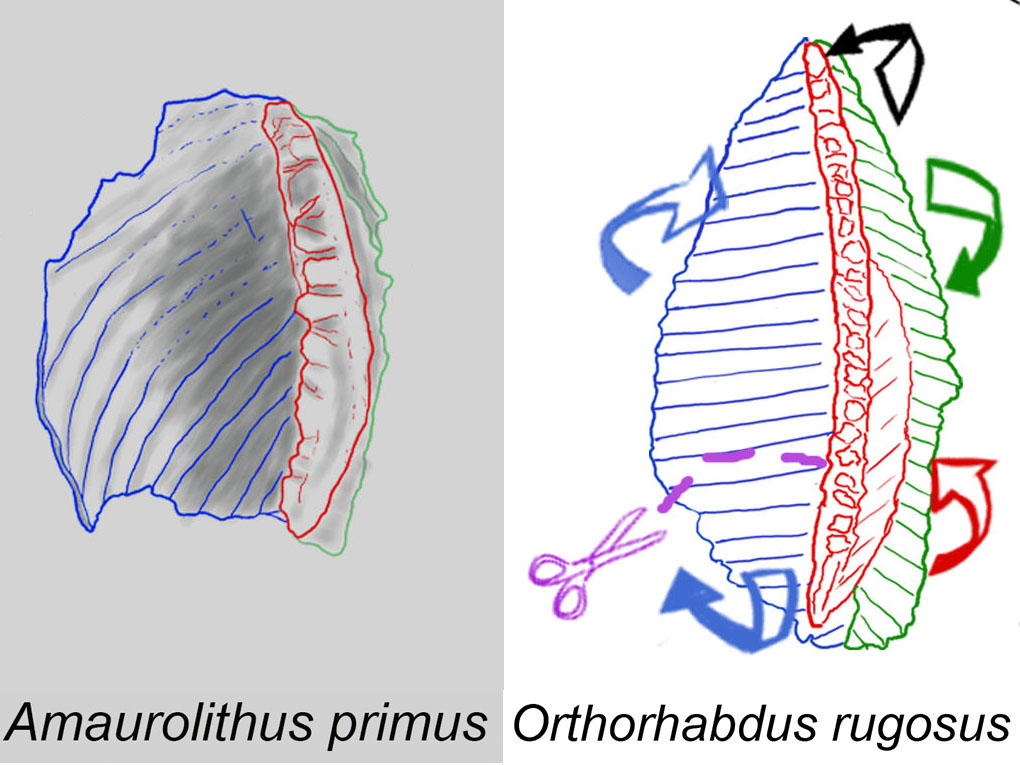
 Sediment samples from Ocean Drilling Program (ODP) Sites 999 and 1237 in the Caribbean Sea and Eastern Pacific Ocean were studied to monitor the evolution of ceratoliths from 7.4 Ma to 6 Ma. Orthorhabdus rugosus shows high variability at the end of the Tortonian to the Early Messinian (7.35 Ma to 6.91 Ma), resulting in the Amaurolithus (7.354 Ma) and Nicklithus branches (6.985 Ma). Orthorhabdus rugosus is an ortholith with three blades (sinistral, median, and dextral). The first ceratholith, A. primus, has two arms and a horseshoe shape with marked laths, and is stable and concave upwards. Its sinistral arm is formed from the sinistral blade of Orthorhabdus rugosus and the right arm is formed from the other blades.

The sudden appearance of A. primus in the sedimentary record at around 7.35 Ma was observed in both studied sections . The  Figure shows the set modifications of O. rugosus producing the early A. primus. The modifications are not a gradual evolutionary sequence of intermediate progressively modified forms but occur simultaneously as they are present from the beginning of the first recorded specimens. Amaurolithus primus coexisted with the O. rugosus ancestor in the studied samples. 

Modification on O. rugosus: Shortening of the specimen; Sinistral blade (blue): Lateral lengthening and its end portion curved upwards, concave to the observer; Dextral blade (green): Rotates backward; Median blade (red): Elevates and becomes more robust showing more marked teeth.

Cite as: Lancis, C., Tent-Manclús, J.-E., Flores, J.-A., 2022. Origin and evolutionary trends of the Neogene genera Amaurolithus and Nicklithus (calcareous nannofossils). Mar. Micropaleontol. 175, 102156. https://doi.org/https://doi.org/10.1016/j.marmicro.2022.102156

Marine Geology field trip to Nijar and Sorbas

As the last year, students of the third course of Marine sciences of the Alicante University visit the Sorbas basin, Cabo de Gata, Hoyazo de Nijar, and Cerro del Espíritu Santo of Vera.  The visit took place on 7 and 8 of November of 2019.

The visit was organized by Antonio Estévez, Santiago Moliner, and José Enrique Tent-Manclús.

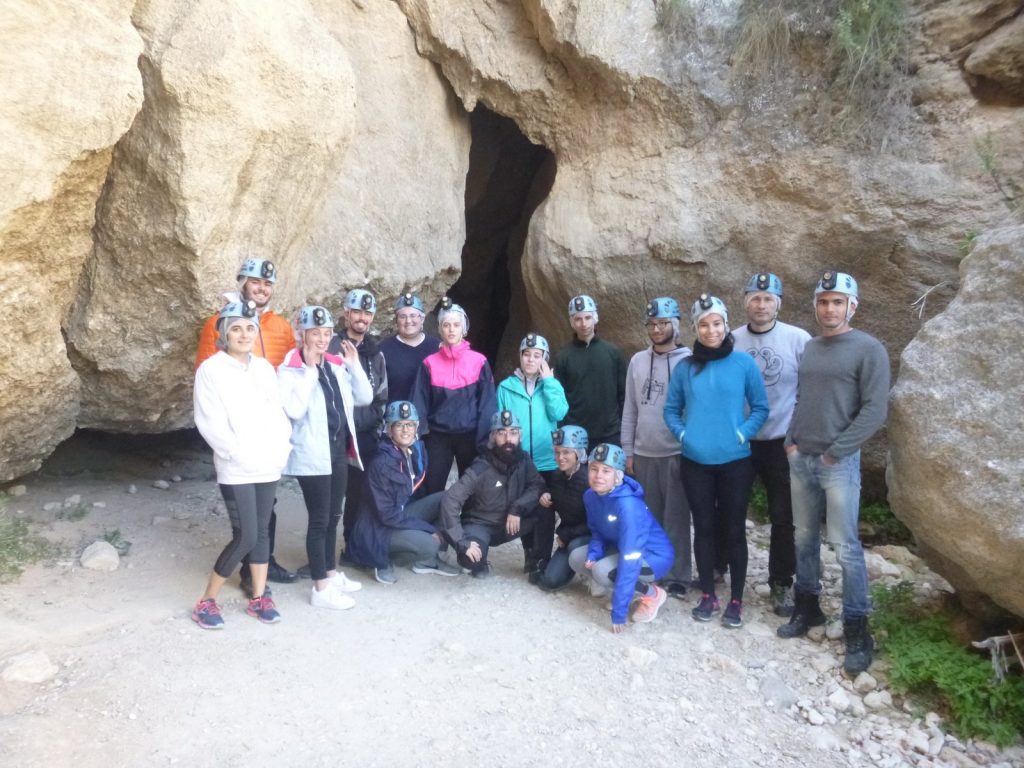
Student group before entering the Sorbas Cave.

Members of the Alicante Messinian Group

The team leader is the Professor Jesús M. Soria of the Alicante University.

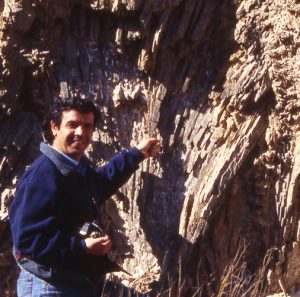
Jesús Soria (in the 90’s) pointing to a palm-tree-gypsum  near Benejúzar (Alicante).


Team Members:

Antonio Estévez

Alfonso Yébenes

José Antonio Pina

José Enrique Tent-Manclús

Ignacio Fierro

José Francisco Baeza-Carratalá

Alice Giannetti

Hugo A. Corbi

Juan J. Peral

https://dctma.ua.es

https://imem.ua.es