James Clerk Maxwell, the man who changed the world forever

150th anniversary of the electromagnetic theory of light

In 1865, one hundred and fifty years ago, James Clerk Maxwell (1831-1879) published an article titled A Dynamical Theory of the Electromagnetic Field, which not only included the electromagnetic field equations (today known as «Maxwell’s equations»), but also predicted the existence of electromagnetic waves moving at the speed of light, and presented the electromagnetic theory of light. In this article he stated: «it seems we have strong reason to conclude that light itself (including radiant heat, and other radiations if any) is an electromagnetic disturbance in the form of waves propagated through the electromagnetic field according to electromagnetic laws». He was not wrong. Then, in 2015, we celebrate the 150th anniversary of the electromagnetic theory of light, which is one of the milestones commemorated in the International Year of Light and Light-Based Technologies (IYL 2015).

James Clerk Maxwell

Maxwell is considered as one of the most important scientists of all time and one of the greats in the history of physics, along with Newton and Einstein. Undoubtedly, his more important scientific contribution is the theory of the electromagnetic field, fundamental not only for the comprehension of natural phenomena, but also for its technical application, in particular in the today ever-present field of telecommunications. He was born in Edinburgh, Scotland, on 13 June 1831 to a well-established family. Two years later, the family moved to a small country estate in Middlebie, Galloway, about 90 miles southwest of Edinburg. His father had been inherited his estate and there he enthusiastically began to supervise the construction of a new house, which he called “Glenlair.” In Glenlair James Clerk Maxwell not only spent long periods of times but also he wrote some of his more important scientific contributions. After receiving private education in Glenlair, James was sent to Edinburgh Academy, where he spent five years. In 1847 he enrolled at Edinburgh University and, three years later, he went up to the University of Cambridge, the most influential center of physics at the time, where he graduated as Second Wrangler in the Mathematical Tripos of 1854 and he won the Smith Prize the same year. In the Smith’s Prize examination, question 8 was on Stokes’ Theorem. Some years later Maxwell would use this theorem in his work on the electromagnetic field.

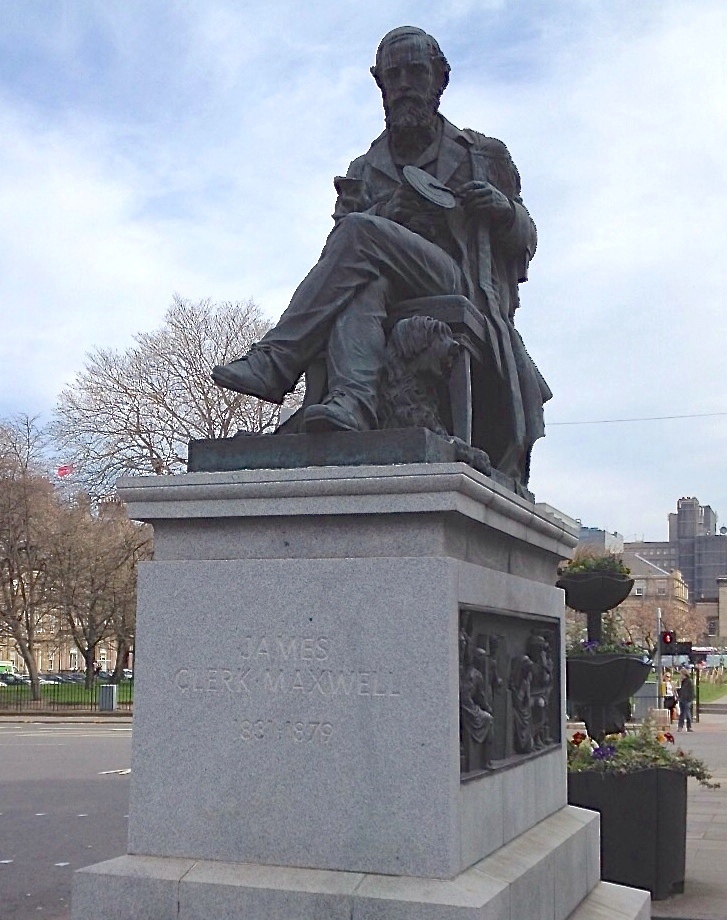
Statute James Clerk Maxwell with his dog Toby at his feet and holding his colour wheel, Edinburgh (Scotland). Credit: A. Beléndez.

Statute James Clerk Maxwell with his dog Toby at his feet and holding his colour wheel, Edinburgh (Scotland). Credit: A. Beléndez.

In 1856, Maxwell got the Chair of Natural Philosophy at Marischal College, one of the two universities in Aberdeen at that time, where he spent four years. There he began his researches on colour theory and married Katherine Mary Dewar, daughter of the College Principal. Perhaps is less known that Maxwell was awarded the Adams Prize with an essay titled On the stability of the motion of Saturn’s rings which was published in 1859 and where he concluded that «the only system of rings which can exist is one composed of an indefinite number of unconnected particles, revolving around the planet with different velocities according to their respective distances.» Maxwell’s work about the Saturn’s rings was defined by George Airy, the Astronomer Royal, as «one of the most remarkable applications of mathematics to physics that I have ever seen.» In 1895, sixteen years after Maxwell’s death, the spectroscopic study made by the American astronomer James Keeler confirmed the theory of Maxwell that Saturn’s rings are made up of countless small objects.

A young James Clerk Maxwell holding his color Wheel. Créditos: James Clerk Maxwell Foundation.

In 1860, he left Aberdeen to occupy another professorship in King’s College, London. The five years Maxwell spent in London were probably the most creative in his life: colour vision and gas kinetic theories as well as the dynamical theory of the electromagnetic field. There he also produced the world’s first colour photography, which was projected onto a screen at the Royal Institution in May of 1861. Maxwell was elected to the Royal Society three weeks later.

Maxwell is also one of the founders of statistical physics. In 1860 he published Illustrations of the dynamical theory of gases in which he needed only one page to obtain the distribution law of molecular speeds that bears his name. Maxwell was the first to formulate a statistical law that governs a physical phenomenon. Again, and as happened with his hypothesis of Saturn’s rings, this law also was proven experimentally in this case by the German physicist Otto Stern in 1920 using the molecular ray method.

Maxwell resigned his King’s professorship voluntarily in 1865, mid session, and went back to his Scottish estate in Glenlair. He wrote his magnus opus there, A Treatise on Electricity and Magnetism, published in 1873, two volumes of more than 500 pages each, peak of nineteenth century physics and comparable to Newton’s Principia, published almost two centuries before. In his Treatise Maxwell manages to unify all known phenomena at the moment regarding electricity and magnetism.

In 1871, Maxwell was appointed to take up the newly created Professorship of Experimental Physics at the University of Cambridge, and he became the first director of a new research centre, the Cavendish Laboratory, and became the first Cavendish Professor of Physics. Other directors who succeeded him were Lord Rayleigh, J. J. Thomson and Rutherford. To date 29 Nobel Prize winners have worked in the Cavendish Laboratory. He supervised every detail of the construction of the Laboratory. In 1877, Maxwell’s health started to fail. He passed away due to an abdominal cancer on 5 November 1879. He was 48. Before dying, one of the things that most concerned to Maxwell was the future of his wife Katherine, whom he so loved.

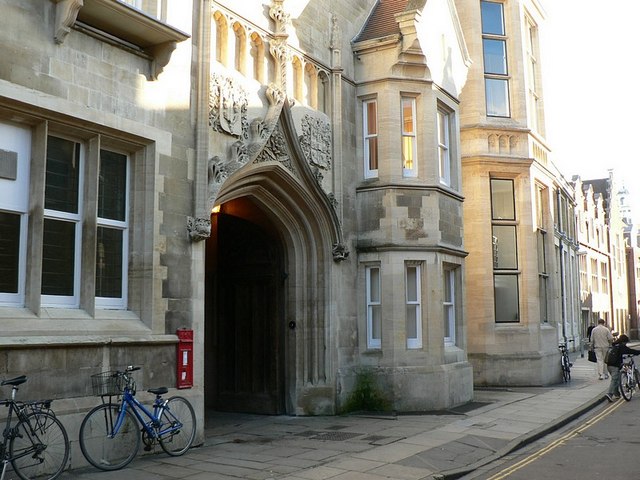
The Old Cavendish Laboratory. © Copyright Rich Tea and licensed for reuse under this Creative Commons Licence.

A Dynamical Theory of the Electromagnetic Field

Maxwell left us contributions to colour theory, optics, Saturn’s rings, statics, dynamics, solids, instruments and statistical physics. However, his most important contributions were to electromagnetism. In 1856, he published On Faraday’s lines of force; in 1861, On physical lines of force. In these two articles he provided a mathematical explanation for Faraday’s ideas on electrical and magnetic phenomena depending on the distribution of lines of force in space, definitively abandoning the classical doctrine of electrical and magnetic forces as actions at a distance. His mathematical theory included the aether, that «most subtle spirit», as Newton described it. He studied electromagnetic interactions quite naturally in the context of an omnipresent aether. Maxwell stood firm that the aether was not a hypothetical entity, but a real one and, in fact, for physicists in the nineteenth century, aether was as real as the rocks supporting the Cavendish Laboratory.

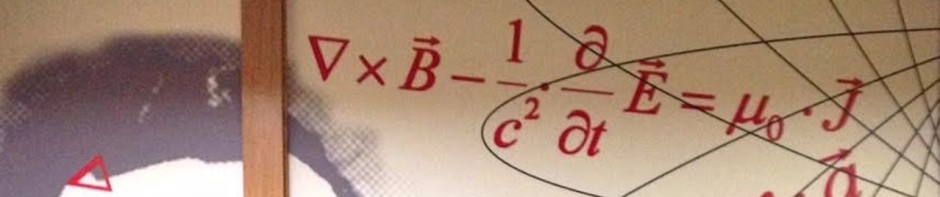
As has been mentioned at the beginning, in 1865 –when Maxwell was 33– he published A Dynamical Theory of the Electromagnetic Field –probably his most important paper–, where he presented a complete electromagnetic theory and which included twenty equations he called «General Equations of the Electromagnetic Field.» He links them to twenty variables governing the behaviour of electromagnetic interaction. The article is 53 pages long, divided in seven parts. His general equations, which summarised the experimental laws of electromagnetism, provide a complete theoretical basis for the treatment of classical electromagnetic phenomena. In 1884, Oliver Heaviside rewrote the twenty equations of the electromagnetic field using vectors into the today’s modern notation: the four equations of electromagnetic field. Since then, these equations were known as Hertz-Heaviside’s equations or Maxwell-Hertz’s equations, until 1940 when Albert Einstein coined the term «Maxwell’s equations» that we use today. The Austrian physicist Ludwig Boltzmann considered them such beautiful equations in their simplicity and elegance that, with a quote from Goethe’s Faust, he asked himself: «War es ein Gott, der diese Zeichen schrieb?» (Was it a god who wrote these signs?).

In the sixth part of his 1865 paper, «Electromagnetic Theory of Light», in which he refers to the paper titled Thoughts on Ray-vibrations published by Faraday in 1846, saying «… the electromagnetic theory of light as proposed by him, is the same in substance as that which I have begun to develop in this paper, except that in 1846 there were no data to calculate the velocity of propagation.» Maxwell also concludes that «light and magnetism are affections of the same substance, and that light is an electromagnetic disturbance propagated through the field according to electromagnetic laws.» As Arthur Zajonc pointed out in his book Catching the Light, «In this single sentence, Maxwell proposed a profound change in our image of light, one is which light, electricity, and magnetism would now, and forever after, be entwined. Two arenas of physics, which to all outward appearances have nothing in common, were to be united.» When he wrote «affections of the same substance», that substance was the ether. Although Maxwell’s mathematical formulation did not require the ether, it was still omnipresent. He proved that the equations of the electromagnetic field could combine into a wave equation and suggested the existence of electromagnetic waves. Calculating the speed of propagation of these waves, he obtained the value of the speed of light, and concluded that it was an electromagnetic wave. Einstein referred to that crucial moment of Maxwell by pointing out: «Imagine [Maxwell’s] feelings when the differential equations he had formulated proved to him that electromagnetic fields spread in the form of polarised waves, and at the speed of light! To few men in the world has such an experience been vouchsafed» Maxwell deduced that electromagnetic waves are transverse waves and he got what is now known as «Maxwell relation» between the refractive index of a medium and the square root of its dielectric constant.

In 1888, nine years after Maxwell’s death, Heinrich Hertz probed experimentally the existence of electromagnetics waves. This meant not only the confirmation of Maxwell’s theory but also a win over telegraph engineers as William Preece, Engineer-in-Chief of the British General Post Office, which denied the applicability of Maxwellian physics to engineering. If Maxwell had lived in 1901 when the Italian engineer and Nobel Prize in Physics in 1909 Guglielmo Marconi made the first transatlantic radio communication across the Atlantic ocean, from Cornwall (England) to St. John’s, in Newfoundland (Canada) –using the electromagnetic waves whose existence Maxwell had predicted in 1865– perhaps Maxwell’s fame would be far greater today.

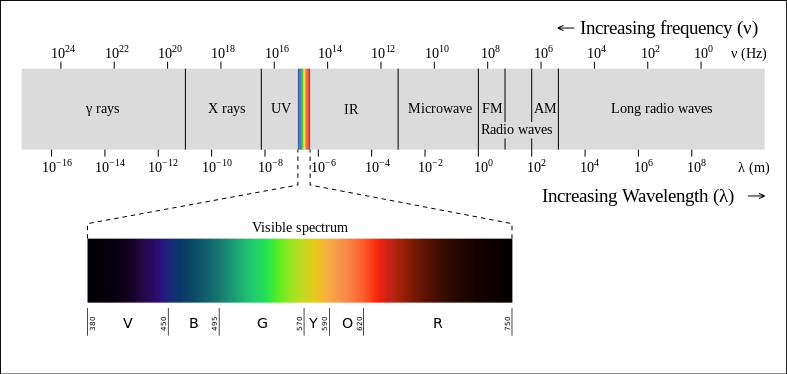
The significance of Maxwell’s concept of electromagnetic waves, as subsequent history has shown, goes far beyond its application to light. Gamma rays, X rays, ultraviolet radiation, visible light, infrared radiation, microwaves and radio and television waves constitute the spectrum of electromagnetic waves, whose existence was predicted by Maxwell 150 years ago.

Electromagnetic spectrum with visible light highlighted (Wikipedia. Author: Philip Ronan).

With his work, Maxwell unified electricity, magnetism and light, which are known as «Maxwell’s synthesis.» Such a synthesis set a milestone in the history of the unification of forces that were so powerful that many nineteenth-century physicists thought the physical laws were already sufficiently comprehended. This led physicist and Nobel Prize in Physics in 1907 Albert Michelson to write in his book Light and Their Uses published in 1903: «The more important fundamental laws and facts in physical sciences have all been discovered, and these are now so firmly established that the possibility of their ever being supplanted in consequence of new discoveries is exceedingly remote … Our future discoveries must be looked for in the sixth place of decimals.» Nothing could be further from the truth. In the first years of the twentieth century there were two Kuhnian paradigm shifts in physics: Planck’s quantum theory (1900) and Einstein’s theory of special relativity (1905), both consequences of Maxwell’s electromagnetic theory and related to light, which laid the groundwork for these two revolutionary ideas. It is clear that Maxwell opened the doors for twentieth century physics.

Maxwell’s Legacy

Although Maxwell’s work on electromagnetism was essential, it had got some limitations, like trying to reconcile Newtonian mechanics and maxwellian electromagnetism. This problem was finally solved in 1905 when Einstein published his theory of special relativity. After Einstein’s works, the luminiferous aether –the focus of nineteenth century physics– was dead and buried. Even Albert Einstein recognised that his «the special theory of relativity owes its origins to Maxwell’s equations.» In 1931, at the centenary of Maxwell’s birth, in an article titled Maxwell’s influence on the development of the conception of physical reality, Einstein claimed that «one scientific epoch ended and another began with James Clerk Maxwell» and «the work of James Clerk Maxwell changed the world forever.»

Richard Feynman, Nobel Prize in Physics in 1965 for his work in quantum electrodynamics (QED), the quantum theory of the electromagnetic field, pointed out: «From a long view of the history of mankind, seen from, say, ten thousand years from now, there can be little doubt that the most significant event of the 19th century will be judged as Maxwell’s discovery of the laws of electrodynamics.»

MORE INFORMATION:

Augisto Beléndez, “Electromagnetic Unification: 150th Anniversary of Maxwell’s Equations”, Mètode Nº 84, Winter 2014/15.

J. C. Maxwell, “A Dynamical Theory of the Electromagnetic Field”, Philosophical Transactions of the Royal Society of London, 155: 459-512 (1865).

L. Campbell and W. Garnett, The life of James Clerk Maxwell (MacMillan and co., Londres 1882).

N. Forbes and B. Mahon, Faraday, Maxwell, and the Electromagnetic Field: How two men revolutionized Physics (Prometheus Books, New York 2014).

R. Flood, M. McCartney and A. Whitaker (eds.), James Clerk Maxwell. Perspectives on his Life and Work (Oxford University Press, Oxford 2014).

Posted in Año de la Luz-2015, Biografías, Divulgación, Historia de la Física | Tagged , , , , , | Comments Off on James Clerk Maxwell, the man who changed the world forever

Per què estem celebrant un any internacional de la llum?

L’ésser humà sempre ha sentit i segueix sentint una gran fascinació per la llum, gràcies a aquests magnífics òrgans del cos humà que són els ulls. Fenòmens lluminosos com l’arc de Sant Martí, l’aurora boreal, el parheli, la fata Morgana o simplement les eixides i postes de Sol ens continuen meravellant com ja succeïa amb els nostres avantpassats. La veritat és que la llum afecta cada dia de la nostres vides. És evident que la llum emesa pel Sol té un paper fonamental en el desenvolupament de la vida a la Terra i és la principal font d’energia del nostre planeta. A la pregunta «què rebem del Sol?», immediatament contestaríem «llum i calor», i fins i tot n’hi ha qui afegiria «rajos ultraviolats», dels quals, per sort per a la nostra salut, l’atmosfera terrestre ens protegeix en una mesura més o menys gran. No obstant això, realment no es tracta de tres coses diferents, sinó que és només una: energia en forma d’ones electromagnètiques amb longituds d’ona corresponents a les radiacions visible, infraroja i ultraviolada, que produeixen en els nostres cossos efectes i sensacions diferents.

El 20 de desembre de 2013, l’Assemblea General de les Nacions Unides va proclamar el 2015 «Any Internacional de la Llum i de les Tecnologies Basades en la Llum» per a fer palès el paper fonamental que exerceix la llum i les seues tecnologies en totes les activitats humanes. La llum és a l’origen de la vida, ha inspirat la bellesa, pintors, poetes, arquitectes…, i és essencial en fotografia, cinema, teatre o televisió, perquè no hi ha dubte que afecta la resposta emocional de l’audiència. N’hi ha prou amb mirar al nostre voltant per a comprovar que les nombroses aplicacions de la llum han revolucionat la societat a través de la ciència, l’enginyeria, l’arquitectura, la medicina, les comunicacions, la cultura, l’art i fins i tot l’oci.

Any-llum-2015

Avui dia, l’òptica i les seues tecnologies han eixit de les universitats i dels laboratoris de recerca i formen part de la nostra vida quotidiana. Les trobem en hospitals i indústries de tota mena. L’òptica s’ha convertit en una de les disciplines científiques amb un dels futurs més estimulants i prometedors, i les indústries relacionades amb la llum són autèntics motors econòmics que mouen centenars de milers de milions d’euros a tot el món. Des de la invenció del làser el 1960, un dels instruments científics més importants i versàtils, l’òptica i la fotònica satisfan cada vegada més necessitats de la humanitat en molts vessants. Donen accés a la informació, faciliten les comunicacions, ajuden a preservar el patrimoni cultural, promouen el desenvolupament sostenible i augmenten la salut i el benestar socials. Les tecnologies basades en la llum també aporten noves solucions als problemes mundials en camps com l’energia, l’educació, l’agricultura, el medi ambient i la sanitat. Ja es parla de la fotònica «verda» (green photonics), els reptes de la qual són el desenvolupament de sistemes òptics per a la generació d’energia neta i renovable, els dispositius d’il·luminació de baix consum i l’ús de materials i components òptics respectuosos amb el medi ambient. No obstant això, la llum a voltes no solament és important per la seua presencia, sinó també per la seua absència. La contaminació lumínica s’ha convertit en un autèntic problema dels països més desenvolupats que no solament afecta les observacions astronòmiques –ja no podem veure la Via Làctica quan mirem al cel a la nit–, sinó també ocells, insectes, tortugues i altres criatures nocturnes, a més d’implicar un autèntic malbaratament d’energia. És indubtable que l’estudi de la llum i les seues tecnologies s’ha convertit en una disciplina transversal clau de la ciència i la tecnologia del segle xxi, motiu pel qual és essencial que siguem plenament conscients de la importància de l’estudi científic de la llum i l’aplicació de les tecnologies basades en la llum per al desenvolupament sostenible mundial. Això demana inversions públiques i privades que permeten desenvolupar projectes de recerca en els diferents àmbits relacionats amb la llum i les seues tecnologies. Igual que de vegades s’ha denominat el segle xx com el segle de l’electrònica, potser el segle xxi serà el segle de la llum, fonamentalment gràcies als avanços en òptica i fotònica esdevinguts durant els darrers cinquanta anys.
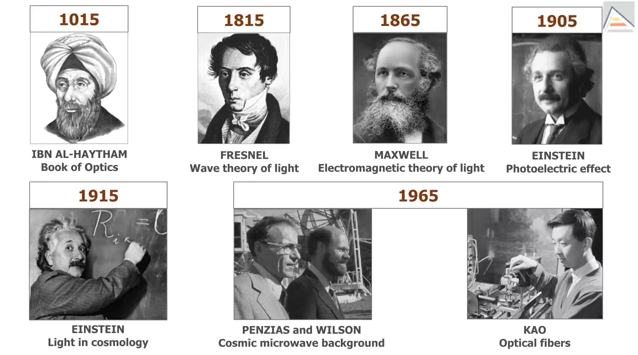
Però, per què 2015? La resposta és que enguany es commemoren una sèrie de fites fonamentals en la història de la ciència de la llum. Fa mil anys, el 1015, Ibn al-Haytham (Alhazen) va publicar el seu Llibre de l’òptica. Fa dos-cents anys, el 1815, Augustin Fresnel va elaborar la teoria ondulatòria de la llum, i fa cent cinquanta anys, el 1865, James Clerk Maxwell proposava la teoria electromagnètica de la llum amb la qual aconseguiria unificar llum, electricitat i magnetisme. Albert Einstein va explicar l’efecte fotoelèctric mitjançant quàntums de llum el 1905, i fa un segle, l’any 1915, va introduir la llum en la cosmologia a través de la seua teoria de la relativitat general, confirmant el paper fonamental de la llum en l’espai i en el temps. Finalment, fa cinquanta anys, Arno Allan Penzias i Robert Woodrow Wilson van descobrir la radiació còsmica de fons de microones, aquest tornaveu de l’origen de l’Univers considerat una de les proves del big bang, i també són del 1965 els resultats obtinguts per Charles Kuen Kao en la transmissió de llum per fibres òptiques, fonament de les actuals i avui omnipresents comunicacions òptiques. A això cal afegir que Einstein, Penzias i Wilson, i Kao van ser guardonats amb el Premi Nobel de Física el 1921, 1978 i 2009, respectivament, precisament per aquestes contribucions relacionades amb la llum. La commemoració d’aquestes fites constitueix una oportunitat única per a poder desenvolupar activitats educatives i divulgatives amb les quals conscienciar la societat de la importància de la llum i les seues tecnologies.

Albert Einstein va declarar el 1917:

Durant la resta de la meua vida reflexionaré sobre el què és la llum.                                       

Aquest any 2015, milions de persones d’arreu del món reflexionaran també sobre aquesta meravella que és la llum i sobre les múltiples maneres en què la llum i les seues tecnologies poden millorar les nostres vides.

Posted in Año de la Luz-2015, Divulgación, Historia de la Física, Investigación | Tagged , , , , , | Comments Off on Per què estem celebrant un any internacional de la llum?

Why celebrate an International Year of Light?

Humans have always felt –and still feel– fascination for light, mainly thanks to those magnificent organs of the human body which are the eyes. Luminous phenomena such as rainbows, aurora borealis, sundogs, Fata Morgana or just the rising and the setting of the Sun still amaze us as they did our ancestors before us. The truth is that light affects every day of our lives. Clearly, the light emitted by the Sun plays a fundamental role in the development of life on Earth and it is the main source of energy for our planet. If someone asks «what do we get from the Sun?,» we immediately answer: «light and warmth» and some might even add «ultraviolet light», from which – luckily for our health– the Earth’s atmosphere protects us to a greater or lesser extent. However, they are not really three different things, but one and the same: energy in the form of electromagnetic waves with wavelengths corresponding to visible, infrared and ultraviolet radiations, which produce different effects and sensations.

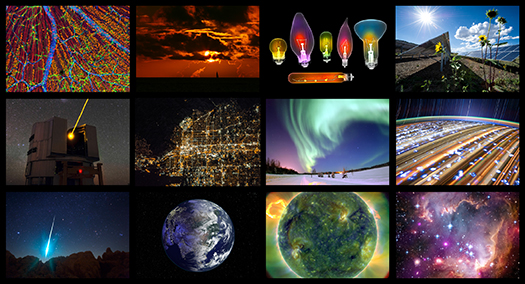
On 20 December 2013, the United Nations General Assembly 68th Session proclaimed 2015 the International Year of Light and Light-based Technologies (IYL 2015) to highlight the fundamental role of light and its technologies in all human activities. Light is at the origin of life, it has inspired beauty, painters, poets, architects … and is essential to photography, cinema, theatre or television because there is no doubt that light affects the emotional response of the audience. We just need to look around us to verify that the numerous applications of light in science, engineering, architecture, medicine, communications, culture, art and leisure have revolutionized society.

IYL2015-blog

The industries related to light are true economic engines and with the invention of the laser –one of the most important and versatile scientific instruments– Optics and photonics are increasingly meeting the needs of humanity in multiple aspects. They give access to information, facilitate our communications, help to preserve our cultural heritage, promote sustainable development and enhance health and social welfare. Light–based technologies are also providing new solutions to various global issues in areas such as energy, education, agriculture, environment and health. However, excessive light may sometimes have adverse consequences. Light pollution has become one of the biggest problems in developed countries since it not only affects astronomical observations –the Milky Way is no longer visible in the night sky–, but also birds, insects, turtles and other nocturnal creatures, not to mention the tremendous waste of energy involved. There is no doubt that the study of light and light–based technologies has become a cross-cutting discipline of science and technology in the 21st century. For this reason, it is essential that we be fully aware of the importance of the scientific study of light and the application of light-based technologies for sustainable global development. This requires public and private investment to develop research projects in different fields related to light and technologies. In the same way that the 20th century has sometimes been called the century of electronics, perhaps the 21st century will be known as the century of light, mainly due to the advances in optics and photonics that have taken place in the last fifty years.

But, why 2015? The answer is that this year coincides with the anniversaries of a series of important milestones in the history of the science of light. One thousand years ago, in 1015, Ibn Al–Haytham published his Book of Optics. Two hundred years ago, in 1815, Fresnel developed the wave theory of light and in 1865, one hundred and fifty years ago, Maxwell proposed the electromagnetic theory of light, whereby he succeeded in unifying light, electricity and magnetism. In 1905 Einstein explained the photoelectric effect using light quanta and in 1915, one hundred years ago, Einstein showed how light was central to cosmology with his theory of general relativity, thereby confirming the fundamental role of light in space and time. Finally, we also commemorate Penzias and Wilson’s discovery of the cosmic microwave background, that eco of the origin of the Universe considered important evidence in support of the Big Bang theory, and Kao’s achievements concerning the transmission of light in fibres for optical communication, which is the basis of current optical communications, both in 1965.

milestones-IYL2015

Let us not forget that Einstein, Penzias and Wilson, and Kao were awarded the Nobel Prize in Physics in 1921, 1978 and 2009, respectively, for their achievements concerning light. The celebration of all these milestones is a unique opportunity to conduct educational and outreach activities to raise public awareness of the importance of light and its technologies in our world.

In 1917 Albert Einstein declared:

for the rest of my life I will reflect on what light is.                                 

During the year 2015, millions of people around the world will reflect on how wonderful light is and the many ways in which light and light–based technologies can improve our lives.

Posted in Año de la Luz-2015, Divulgación, Historia de la Física, Investigación | Tagged , , , , | Comments Off on Why celebrate an International Year of Light?

Celebrando el “Año Internacional de la Luz”

El ser humano siempre ha sentido y siente una gran fascinación por la luz. Fenómenos luminosos como el arco iris, las auroras boreal y austral, el parhelio, el fatamorgana o simplemente las salidas y puestas del Sol nos siguen maravillando como ya sucediera a nuestros antepasados. Lo cierto es que la luz afecta a cada día de nuestras vidas. Es evidente que la luz emitida por el Sol juega un papel fundamental en el desarrollo de la vida en la Tierra y es la principal fuente de energía de nuestro planeta. Ante la pregunta «¿qué recibimos del Sol?», inmediatamente contestaríamos «luz y calor» e incluso algunos añadirían «rayos ultravioleta», de los que por suerte para nuestra salud la atmósfera terrestre nos protege en mayor o menor medida. Sin embargo, realmente no se trata de tres cosas distintas, sino que es sólo una: energía en forma de ondas electromagnéticas con longitudes de onda correspondientes a las radiaciones visible, infrarroja y ultravioleta, que producen en nuestros cuerpos efectos y sensaciones diferentes.

arco-iris

El 20 de diciembre de 2013 la Asamblea General de las Naciones Unidas proclamó 2015 como «Año Internacional de la Luz y de las Tecnologías basadas en la Luz» para poner de manifiesto el papel fundamental que desempeñan la luz y sus tecnologías en todas las actividades humanas. La luz se encuentra en el origen de la vida, ha inspirado la belleza, a pintores, poetas, arquitectos, … y es esencial en fotografía, cine, teatro o televisión, pues no cabe duda que afecta a la respuesta emocional de la audiencia. Basta mirar a nuestro alrededor para comprobar que las numerosas aplicaciones de la luz han revolucionado la sociedad a través de la ciencia, la ingeniería, la arquitectura, la medicina, las comunicaciones, la cultura, el arte y el ocio.

Las industrias relacionadas con la luz son auténticos motores económicos y desde la invención del láser, uno de los más importantes y versátiles instrumentos científicos, la Óptica y la Fotónica satisfacen cada vez más necesidades de la Humanidad en múltiples vertientes. Dan acceso a la información, facilitan las comunicaciones, ayudan a preservar el patrimonio cultural, promueven el desarrollo sostenible y aumentan la salud y el bienestar sociales. Las tecnologías basadas en la luz también aportan nuevas soluciones a los problemas mundiales en campos como la energía, la educación, la agricultura, el medioambiente y la sanidad. Sin embargo, la luz a veces no sólo es importante por su presencia, sino también por su ausencia. La contaminación lumínica se ha convertido en un auténtico problema de los países más desarrollados que no sólo afecta a las observaciones astronómicas –ya no podemos ver la Vía Láctea al mirar al cielo por la noche–, sino también a pájaros, insectos, tortugas marinas y a otras criaturas nocturnas, además de suponer un auténtico despilfarro de energía. Es indudable que el estudio de la luz y sus tecnologías se ha convertido en una disciplina transversal clave de la ciencia y la tecnología del siglo XXI, por lo que resulta esencial que seamos plenamente conscientes de la importancia del estudio científico de la luz y la aplicación de las tecnologías basadas en la luz para el desarrollo sostenible mundial. Esto requiere inversiones públicas y privadas que permitan desarrollar proyectos de investigación en los distintos ámbitos relacionados con la luz y sus tecnologías. Al igual que a veces se ha denominado al siglo XX como el «siglo de la electrónica», quizás el siglo XXI sea el «siglo de la luz», fundamentalmente gracias a los avances en Óptica y Fotónica acaecidos en los últimos cincuenta años.

Año-internacional-de-la-luz

Pero, ¿por qué 2015? La respuesta es que este año se conmemoran una serie de hitos fundamentales en la historia de la ciencia de la luz. Hace mil años, en 1015, Alhazen publicó su Libro de la Óptica. Hace doscientos años, en 1815, Fresnel elaboró la teoría ondulatoria de la luz y en 1865 Maxwell la teoría electromagnética de la luz con lo que consiguió unificar luz, electricidad y magnetismo. Einstein explicó el efecto fotoeléctrico mediante cuantos de luz en 1905 y hace un siglo, en el año 1915, introdujo la luz en la cosmología a través de su Teoría de la Relatividad General, lo que confirmó el papel fundamental de la luz en el espacio y en el tiempo. Por n con otras institucionesolaboraci28 de enero. Ademrnacional de la Luz como as fundamental en el desarrollo de la vida en la Tieúltimo, hace cincuenta años Penzias y Wilson descubrieron la radiación cósmica de fondo de microondas, ese eco del origen del Universo considerado una de las pruebas del Big Bang, y también son de 1965 los logros alcanzados por Kao en la transmisión de luz por fibras ópticas, fundamento de las actuales y hoy omnipresentes comunicaciones ópticas. Añadamos que Einstein, Penzias, Wilson y Kao fueron galardonados con el Premio Nobel de Física precisamente por estos trabajos relacionados con la luz.

La conmemoración de esos hitos constituye una oportunidad única para poder desarrollar actividades educativas y divulgativas con las que concienciar a la sociedad de la importancia de la luz y sus tecnologías.

Albert Einstein señaló en 1917 que durante el resto de su vida reflexionaría sobre lo que es la luz. En este año 2015 millones de personas en todo el mundo reflexionarán también sobre lo maravillosa que es la luz y sobre las múltiples maneras en que ésta y sus tecnologías pueden mejorar nuestras vidas.

Posted in Año de la Luz-2015, Divulgación, Historia de la Física, Investigación | Tagged , , , | Comments Off on Celebrando el “Año Internacional de la Luz”

Los Premios Nobel de Física en el Año Internacional de la Luz: Dennis Gabor (1971)

Premio Nobel de Física 1971

“Por su invención y desarrollo del método holográfico”

Dennis Gabor (1900-1979). Nobel Museum, Stockholm. Credit: A. Beléndez

Dennis Gabor (1900-1979). Nobel Museum, Stockholm. Credit: A. Beléndez

Dennis Gabor (1900-1979) nació el 5 de junio de 1900 en Budapest y aunque la física le fascinaba, decidió estudiar ingeniería. Más tarde escribió, “ser físico no era todavía una profesión en Hungría y ¿con apenas media docena de cátedras de física en todo el país, quién podría haber sido tan presuntuoso para aspirar a una de ellas?”. Al cumplir los dieciocho años fue enviado al norte de Italia para servir en la artillería austro-húngara en los últimos meses de la Primera Guerra Mundial y finalizada la contienda inició estudios de ingeniería en Budapest que concluyó en la Universidad de Berlín donde obtuvo el Título de Ingeniero Eléctrico en 1923 y el de Doctor Ingeniero en 1927. Ese mismo año entró a trabajar en uno de los laboratorios de física de la compañía Siemens & Halske de Berlín, en la que comenzó a desarrollar algunos de sus numerosos inventos. Como prueba de su fructífera labor como inventor presentó 62 patentes entre 1928 y 1971. En 1933, y tras le llegada de Hitler al poder, Gabor abandonó Alemania pues no le renovaron su contrato en la compañía Siemens debido a su origen judío y en 1934 marchó a Inglaterra, donde consiguió un empleo en la British Thomson Houston Company.

A lo largo de su vida Gabor siempre decía que él era ingeniero e inventor en vez de científico, a pesar de que su trabajo estaba casi siempre relacionado con la física aplicada. Pero Gabor, también fue un humanista en el más puro sentido del Renacimiento: lector voraz, escritor, ensayista, hombre preocupado por la sociedad tecnológica de finales del siglo XX y miembro del Club de Roma. Desde 1958 dedicó gran parte de su tiempo al estudio del futuro de nuestra civilización industrial sobre el que publicó, entre otros, el libro Inventando el futuro en el que señalaba “tú no puedes predecir el futuro, pero puedes inventarlo”.

Pero volvamos al año 1947 en el que la holografía comienza su andadura en un laboratorio de una empresa de ingeniería eléctrica en el que Gabor trabajaba en la mejora del microscopio electrónico. Con este instrumento se había aumentado en cien veces el poder de resolución de los mejores microscopios ópticos y se estaba muy cerca de resolver las estructuras atómicas, pero los sistemas no eran lo bastante perfectos. Su limitación estaba relacionada con la aberración esférica de las lentes magnéticas del microscopio. Para resolver este problema Gabor se preguntó: “¿por qué no tomar una mala imagen electrónica, pero que contenga la información ‘total’ de la misma, reconstruirla y corregirla mediante métodos ópticos?”.

Dennis Gabor

La contestación a esta pregunta se le ocurrió mientras esperaba para jugar un partido de tenis el Domingo de Pascua de 1947  y consistía en considerar un proceso en dos etapas. En la primera etapa, el registro, produciría el diagrama interferencial entre el haz de electrones objeto y un fondo coherente que registraría en una placa fotográfica. A este interferograma Gabor lo llamó holograma, del griego ‘holos’, que significa ‘la totalidad’, pues contiene la información total (la amplitud y la fase) de la onda objeto. En la segunda etapa, la reconstrucción, iluminaría el holograma con luz visible, reconstruiría el frente de onda original y podría corregirlo por métodos ópticos para obtener una buena imagen.

Para conseguir franjas de contrastadas es necesario disponer de una fuente de iluminación de gran coherencia, la cual no existía en tiempos de Gabor. A pesar de ello, en 1948 Gabor realizó el primer holograma con luz proveniente de una lámpara de mercurio, una de las mejores fuentes de luz coherente antes del láser. El objeto de este primer holograma era una pequeña diapositiva circular que contenía los nombres “Huygens, Young y Fresnel”, tres físicos a los que Gabor consideraba importantes por haber puesto las bases de su técnica a la que denominó reconstrucción del frente de onda.

Póster de la conferencia de Gabor de 1948 (The MIT Museum – Holography Collection from the Museum of Holography).

Poco después presentó un trabajo más extenso, de treinta y tres páginas, ante la Royal Society de Londres en el que señalaba: “el nombre ‘holograma’ no es injustificado, al ser la fotografía que contiene la información total necesaria para reconstruir el objeto, que puede ser bidimensional o tridimensional”. El New York Times publicó en septiembre de ese mismo año la primera noticia sobre esta nueva técnica, mientras que en diciembre de 1948 Gabor presentó una patente relacionada con la mejora de imagen en microscopía electrónica. Gabor consiguió en 1949 un puesto de profesor en el Imperial College de Londres, gracias a la buena acogida que tuvo su idea de la reconstrucción del frente de onda entre científicos como Sir Lawrence Bragg y Max Born, ambos premios Nobeles de física, y Sir Charles Darwin, nieto del evolucionista y Director del Laboratorio Nacional de Física de Gran Bretaña.

En los años siguientes la técnica fue estudiada por Gordon Rogers en Inglaterra, Adolf Lohmann en Alemania y en la Universidad de Stanford: Paul Kirkpatrick, Albert Baez (padre de las cantantes Joan Baez y Mimi Fariña) y Hussein El-Sum. Este último realizó la primera tesis doctoral sobre holografía en 1952 y en el periodo comprendido entre 1948 y 1955 se publicaron unos cincuenta artículos sobre la técnica de Gabor.

Sin embargo, sólo se consiguieron imágenes pequeñas y borrosas y hacia 1954 Gabor estaba frustrado hasta el punto de la desesperación, intentando, sin éxito, convencer a sus colaboradores que continuaran con las investigaciones. Pero todos ellos habían perdido el interés por dos razones importantes. La primera, la imposibilidad de obtener resultados óptimos cuando aplicaban el método al microscopio electrónico y la segunda, la etapa de reconstrucción del holograma que era imperfecta. El método de Gabor genera un holograma en eje cuya calidad es pobre debido al solapamiento de la imagen virtual y la imagen real o conjugada. Al contemplar la imagen virtual o la real siempre aparece la otra imagen desenfocada como fondo. En 1955, y tras investigar varios montajes ópticos para minimizar el efecto de la imagen conjugada, Gabor abandonó sus investigaciones sobre holografía.

Gordon Rogers, quizás el más entusiasta de los primeros investigadores en holografía, escribía: “por lo que a mí respecta, estoy feliz de dejar que la técnica de reconstrucción del frente de onda muera de forma natural; le veo relativamente poco futuro y estoy deseando dedicarme a otra cosa”. Hasta tal punto pensaba Gabor que no era un tema importante que, en 1958, cuando se presentó a una cátedra en el Imperial College, apenas mencionó su trabajo sobre microscopía por reconstrucción del frente de onda.

La explosión holográfica, originada en los Estados Unidos entre 1962 y 1965 gracias a las contribuciones de Leith y Upatnieks y a las de otros investigadores de la Universidad de Michigan, rehabilitó la figura de Gabor que pasó de ser prácticamente un desconocido a recibir en 1971 el Premio Nobel de Física “por la invención y desarrollo del método holográfico”.

Dennis Gabor recogiendo el Premio Nobel de Física de 1971 de las manos del Rey Gustavo Adolfo VI de Suecia.

BIBLIOGRAFÍA

Dennis Gabor, “Autobiography” (http://www.nobelprize.org).

Posted in Año de la Luz-2015, Biografías, Divulgación, Historia de la Física, Premios Nobel | Tagged , , , , , | Comments Off on Los Premios Nobel de Física en el Año Internacional de la Luz: Dennis Gabor (1971)