Koudiat El Madene unit (Kabylian “Dorsal”, Algeria) and its correlation

The Koudiat El Madene Unit (Arba Massif) belongs to the Kabylian “Dorsal” (Algerian Internal Zone). The stratigraphy and tectonic structuring of the area is equivalent to the western Moroccan Internal Rif and its counterpart in the Spanish Internal Betic Cordillera. In fact, all these chain segments are due to a common Cenozoic geodynamic evolution related to the closure of the westernmost Tethys and the later opening of the Mediterranean Sea. Nevertheless, a comparison of the Kabylian internal units at the western Mediterranean scale was still missing. This study means a revisiting of the outcrops of the Koudiat El Madene Unit and a revision of the existent literature on the area aimed to a comparation of this area with the Algerian Kabylian “Dorsal” and with the Ghomaride (Moroccan Rif) and Malaguide (Spanish Betic Cordillera) equivalents units. This unit crops out in a tectonic window under different backthrusting units of the Maghrebian Flysch Basin Zone and overthrusts southwards the Maghrebian Flysch Basin Zone itself and the External Tellian Zones. This is a frequent tectonic situation of this kind of units in the internal Rif-Betic chains. The condensed succession of the Koudiat El Madene Unit, separated by unconformities but also by internal erosive boundaries, is divided into five stratigraphic formations. Nowadays, the stratigraphic division and dating of the Koudiat El Madene Unit (Algerian Kabyle Unit) are less detailed than its equivalents in the Ghomarides, especially those of the Malaguides. Nevertheless, a correlation with the Ghomaride Units from the Tetouan-Chaouen area (Northern Morocco) and the Malaguide Complex from the Sierra Espuña area (Southeastern Spain) has been performed revealing great similarities. The good correlation can be due to a close paleogeographic position in the southern margin of the Paleo- and Mesomediterranean Microplate. Minor variations should be proposed in relation to the position in the margin. Detailed and modern stratigraphic and sedimentological studies are required to propose a more precise paleogeographic framework.
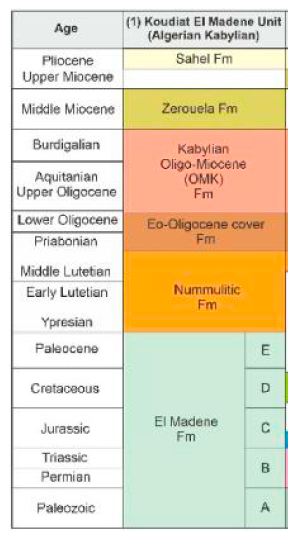

Koudiat El Madene Unit (Algerian Kabylian),
cite as: Talmat, S., Martín-Martín, M., Benyoucef, M., Ferré, B., Belhai, D., 2025. The Koudiat El Madene unit (Kabylian “Dorsal”, Algeria) and its correlation with similar units belonging to the Rif-Betic Arc (Morocco and Spain). J. African Earth Sci. 223, 105515. https://doi.org/https://doi.org/10.1016/j.jafrearsci.2024.105515

The Eocene carbonate platforms of the westernmost Tethys: a review

According to the prevailing view in literature, two Eocene carbonate platform belts developed on northern and southern margins of the Tethys Ocean. However, Eocene platforms in the Malaguide −Ghomaride Units (Betic-Rifian Arc; Spain and Morocco, respectively) in intermediate position to the classic platform belts have been proposed in recent literature. A number of representative Ypresian to Priabonian stratigraphic sections have been revisited and empowered by new data collected for the scope. Ten lithobiofacies (consisting of limestones rich in Larger Benthic Foraminifera (LBF), algae, and corals) and ten microfacies (based on fossil assemblage and their relative abundance, texture, and fabric) were proposed for this intermediate platform belt. The paleoenvironmental reconstruction indicate inner to outer ramps (locally also the upper slope) arranged in two sedimentary sequences rich in LBF and corals. A great development of carbonate seagrass factories in most of the areas in which inner ramps developed has been identified. These factories correspond to a warm-temperate system with warm-water conditions mainly in low latitude settings. Trophic resources proposed in these works suggest oligo- to mesotrophic conditions in inner to mid ramp settings, which only evolve to eutrophic conditions in outer ramp and upper bathyal settings. A comparison of the three belts of carbonate platforms at the western Tethys scale has been performed, providing several important constraints in terms of the recorded time period according to the literature, tectonics, transgressive−regressive trendings, relative abundance of fossils, and paleoenvironmental conditions.


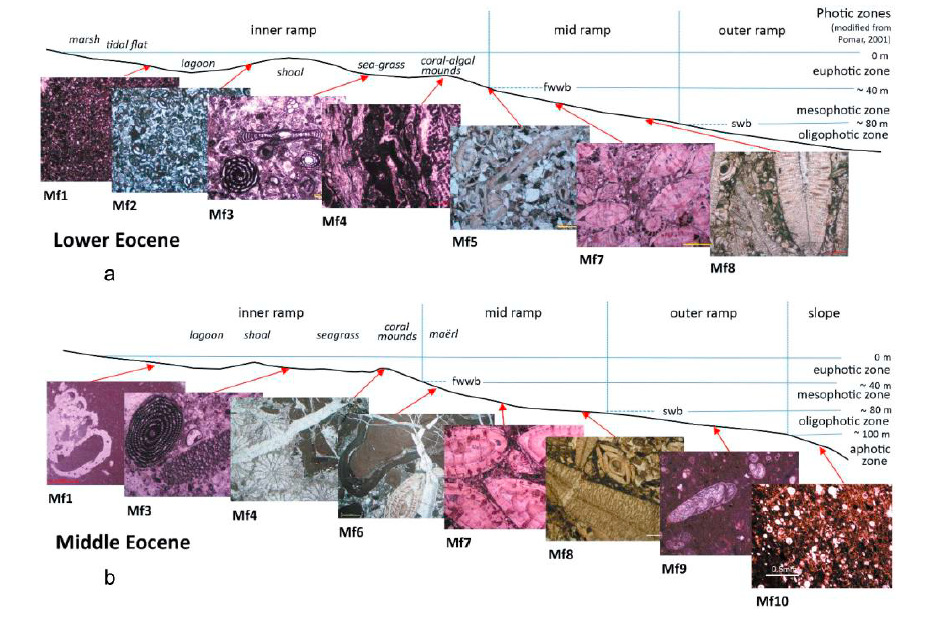
Environmental microfacies distribution for the Eocene marine Malaguide−Ghomaride Domains (modified from Maaté et al. 2000; Martín-Martín et al. 2020, 2021, 2023c; Tosquella et al. 2022). Ramp subdivision is based on Burchette and Wright (1992), while photic zones are modified from Pomar (2001); the new considered ‘mesophotic zone’ (zonation by Hottinger 1997) lies between the lower limit of occurrence of marine vegetation and the last occurrence of Larger Benthic Foraminifera, approximately coinciding with the storm wave base (swb). Key: Mf1, inner ramp lagoon, upper subtidal environment; Mf2, shoal, upper subtidal environment; Mf3, inner ramp seagrass, euphotic upper subtidal environment; Mf4, inner ramp coral-foralgal and acervulinid mounds, euphotic environment; Mf5, transgressive lag deposits in the transition between inner-to-mid ramp, euphotic to mesophotic environment; Mf6, mid ramp foralgal packstone–rudstone, mesophotic ma.rl environment; Mf7, proximal mid ramp LBF accumulations (nummulitids) in a mesophotic environment; Mf8, distal mid ramp LBF accumulations (orthophragminids) in a mesophotic to oligophotic environment; Mf9, outer ramp, oligophotic environment; Mf10, aphotic slope environment.

The Eocene platforms of the westernmost Tethys show a lacunose geological record registered from upper Ypresian (Cuisian) to Bartonian. It shows an important gap at the upper Ypresian (Cuisian)−Lutetian boundary. LBF remained the primary framework builders elsewhere until the Bartonian age, with zooxanthelle−coral build-ups playing a more significant role in the inner ramps than previously assumed.

Cite as: Martín-Martín, M., Tosquella, J., Guerrera, F., Maaté, A., and Martín-Algarra, A. (2024). The Eocene carbonate platforms of the westernmost Tethys: a review. International Geology Review, 1-33. https://doi.org/10.1080/00206814.2024.2397804