Interactive 3D HTML models and visualizations of geological structures derived from classic surface geological information have been developed, for the first time, in a Python environment, using the key case of the tectonic Mula sheets in the Betic Cordillera (southern Spain). These models were performed through several steps: a geological 2D sketch map, creating equispaced geological cross-sections, 3D topography, a complete 3D model, and detailed 3D block diagrams. The result of the extrapolation of the equispaced geological cross-sections and their integration with the geological map into a 3D geological model shows the thrust-faulted and contractionally folded structure of the entire area, which affects the Cretaceous to Lower Miocene succession. The faults (strikeslip and normal) present in the tectonic thrust sheets are also represented. Three detailed 3D HTML blocks of illustrative regions within the modeled area were also created. For the 3D modeling, Bézier curves/surfaces as well as linear interpolation were used, as geological (stratigraphic and tectonic) contacts and surfaces between different stratigraphic units can be expressed geometrically with these tools. Compared to commercial alternatives, our software offers three key advantages: free user-friendly solutions, browser-compatible 3D models, and open-source software. The 3D visualization of stratigraphic-structural architecture enables predictive interpretations with applications in environmental and economic geology (e.g., groundwater, geotechnical studies, mining research, etc.). Moreover, 3D visualization and modeling provide valuable insights into geological phenomena, benefiting both the scientific community and society at large. Furthermore, advances in interactive 3D visualization bridge the gap between cutting-edge geological research and public understanding, enhancing social awareness.
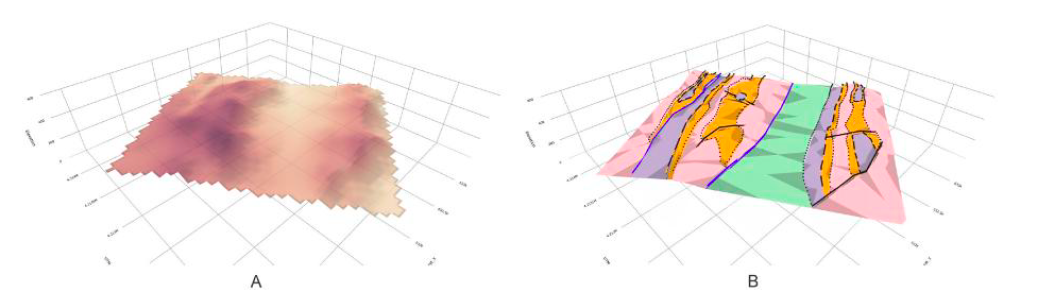
Three-dimensional topographic representations of the Mula sheets area showing: (A) the interpolated digital elevation model surface generated from point grid data using linear interpolation, and (B) the complete geological 3D map with real topography where stratigraphic units (Cretaceous C1-C2 in green, Paleocene P in violet, Eocene E1-E2 in orange-pink) are draped over the topographic surface, with thrust faults displayed in blue and normal faults in black.
Cite as: Bullejos, Manuel, and Manuel Martín-Martín. 2025. 3D Modeling and Visualization of Geological Structures with Python-Implemented Bézier Curves/Surfaces. Journal of Structural Geology 200: 105508. https://doi.org/10.1016/j.jsg.2025.105508.
Tags: Bézier curves/surfaces, Geological 3D HTML models, Linear interpolation., Python environment