
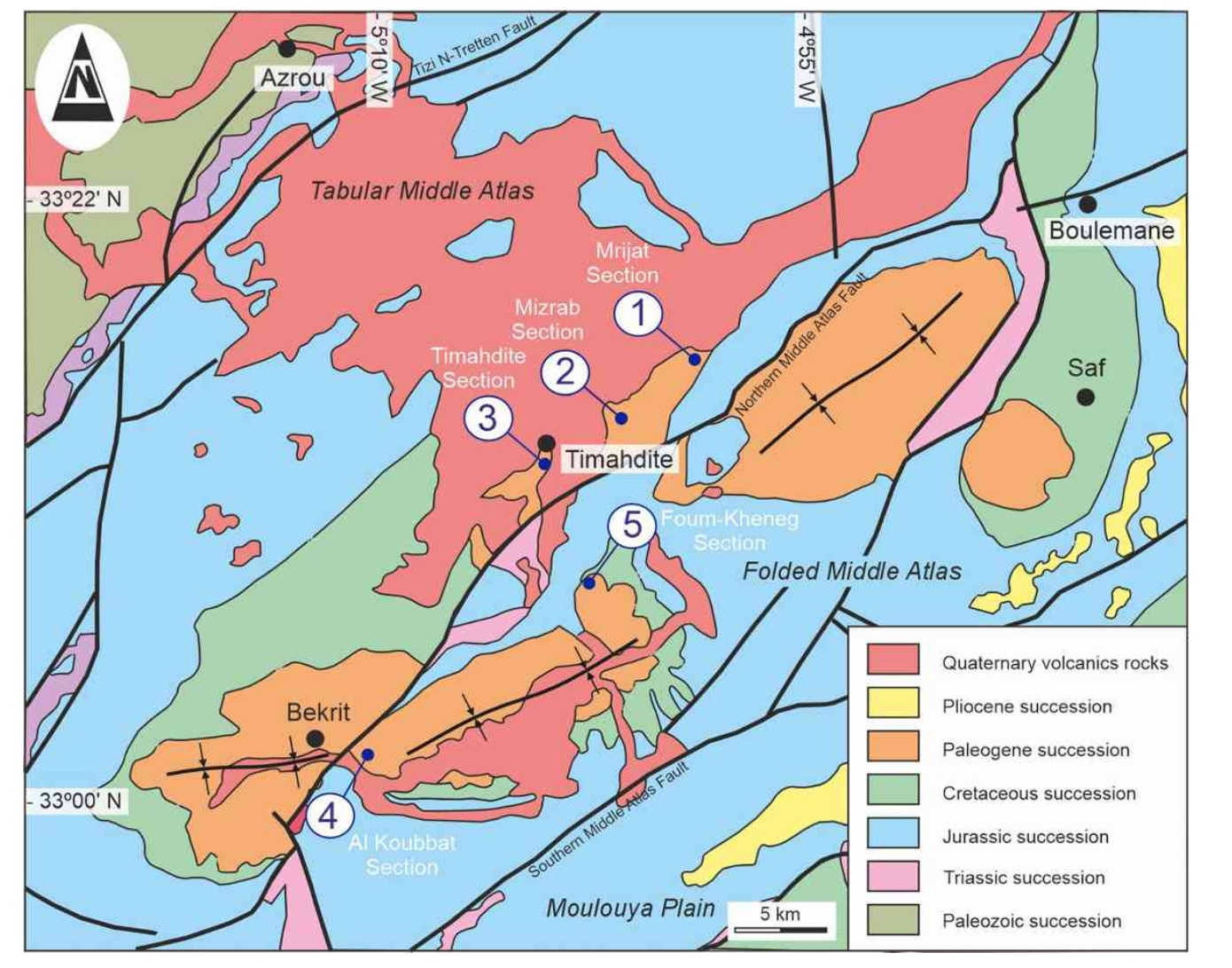
Deciphering the Eocene carbonate platforms of the Bekrit-Timahdite sector (Middle Atlas, Morocco). This study identifies thirteen sedimentary facies (F1 to F13) across five stratigraphic sections, representing shallow marine carbonate platform environments. These are characterized by lithology, sedimentary structures, and macrofossil content including oysters, gastropods, echinoids, algae, fish remains, and bryozoans. A total absence of larger benthic foraminifera (LBF) and zooxanthellate corals (z-corals) has been noticed. Biostratigraphic analysis dated the basement as Maastrichtian (non terminal) and the Paleogene succession as Lutetian. Eight carbonate platform microfacies (Mf1 to Mf8) were defined, covering both inner ramp (tidal flat, lagoon, shoal, and oyster-rich reef bioherm) and mid ramp (reef slope and open marine) environments. The Eocene fossil assemblage indicates the presence of heterotrophic communities thriving in meso- to eutrophic waters, indicative of a tropical, heterozoan carbonate factory dominated by bryozoans and mollusks. Subsidence patterns varied significantly: Logs 4 and 5 (Folded Middle Atlas Block) recorded higher subsidence rates, while Logs 1 to 3 (Tabular Middle Atlas Block) show lower rates. Succession is organized into low-frequency (3rd-order) predominantly transgressive sequences, typically punctuated by rapid regressions and transgressions. These depositional rhythms are interpreted as responses to regional tectonic pulses associated with the Eo-Alpine phase. Regional correlations reveal a striking contrast: while coeval Neo-Tethyan platforms, from Spain to Italy, are characterized by homogeneity and abundant LBF and z-corals, the study area and the Algerian Saharan Domain, lack these taxa, instead featuring sediments rich in phosphates, oysters, and fish remains. This distinctive facies association (heterozoan dominated) reflects nutrient-rich upwelling zones similar to those in the Atlantic. It is proposed that further exploration of a potential narrow corridor, which served as hinterland to the Atlas-Mesetas System during the Paleocene-Eocene period and was influenced by tectonic controls from basement folding, could elucidate the origin of these Atlantic-type deposits.
Cite as: Martín-Martín, M., Tosquella, J., Miclăuș, C., Maaté, A., Tent-Manclús, J. E., Maaté, S., Monteil, E., Serrano, F., Martín-Pérez, J. A. (2026): Deciphering the Eocene carbonate platforms of the Bekrit-Timahdite sector (Middle Atlas, Morocco): The gateway to the Atlantic Domain. Sedimentary Geology, 496, 107055. https://doi.org/10.1016/j.sedgeo.2026.107055