Arjona-Giner, S., Llorens-Largo, F., García-Sigüenza, J., Satorre-Cuerda, R. (2027). A Guided Multi-agent Tutor for Progressive Help in Programming Practice. In: del Jesus, M.J., et al. Advances in Artificial Intelligence. CAEPIA 2026. Lecture Notes in Computer Science(), vol 16999. Springer, Cham. https://doi.org/10.1007/978-3-032-43170-7_5
XXI Conferencia de la Asociación Española para la Inteligencia Artificial (CAEPIA’26)
Del 11 al 13 de Noviembre de 2026 en Jaén
https://simidat.ujaen.es/caepia26
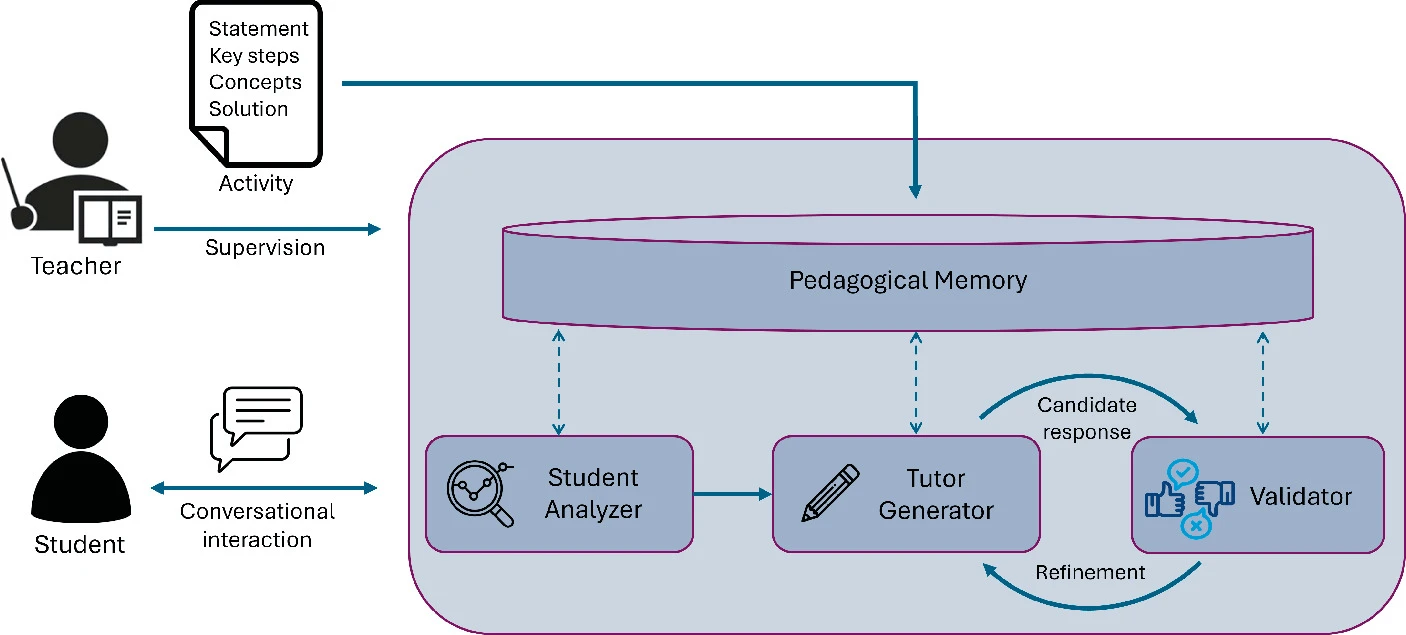
Large Language Models (LLMs) are increasingly used as tutoring assistants in programming education, but their pedagogical value depends not only on response accuracy but also on how much learning help they provide. In particular, LLM-based tutors may over-help students by revealing solution steps too early or by failing to adapt their support to the learner’s current needs. This paper presents a guided multi-agent tutor for progressive help in programming practice. The proposed architecture separates student-state analysis, response generation, and response validation. It also uses an explicit activity characterization to distinguish between explainable concepts and protected solution steps, enabling finer control over solution disclosure. To evaluate the approach, we compare three configurations: a monolithic Socratic baseline, a guided multi-agent tutor without validation, and a full guided multi-agent tutor with validation. Nine computer science teachers evaluated responses generated for introductory Python programming scenarios using three dimensions: pedagogical quality, gradual support, and over-helping. Results show that both guided configurations were perceived as more gradual and less prone to over-helping than the monolithic baseline, while the full architecture achieved the most favorable mean values overall.
Además nos llevamos la alegria de obtener el 2ª Premio al Mejor Artículo CAEPIA 2026